Physical Address
304 North Cardinal St.
Dorchester Center, MA 02124
Physical Address
304 North Cardinal St.
Dorchester Center, MA 02124
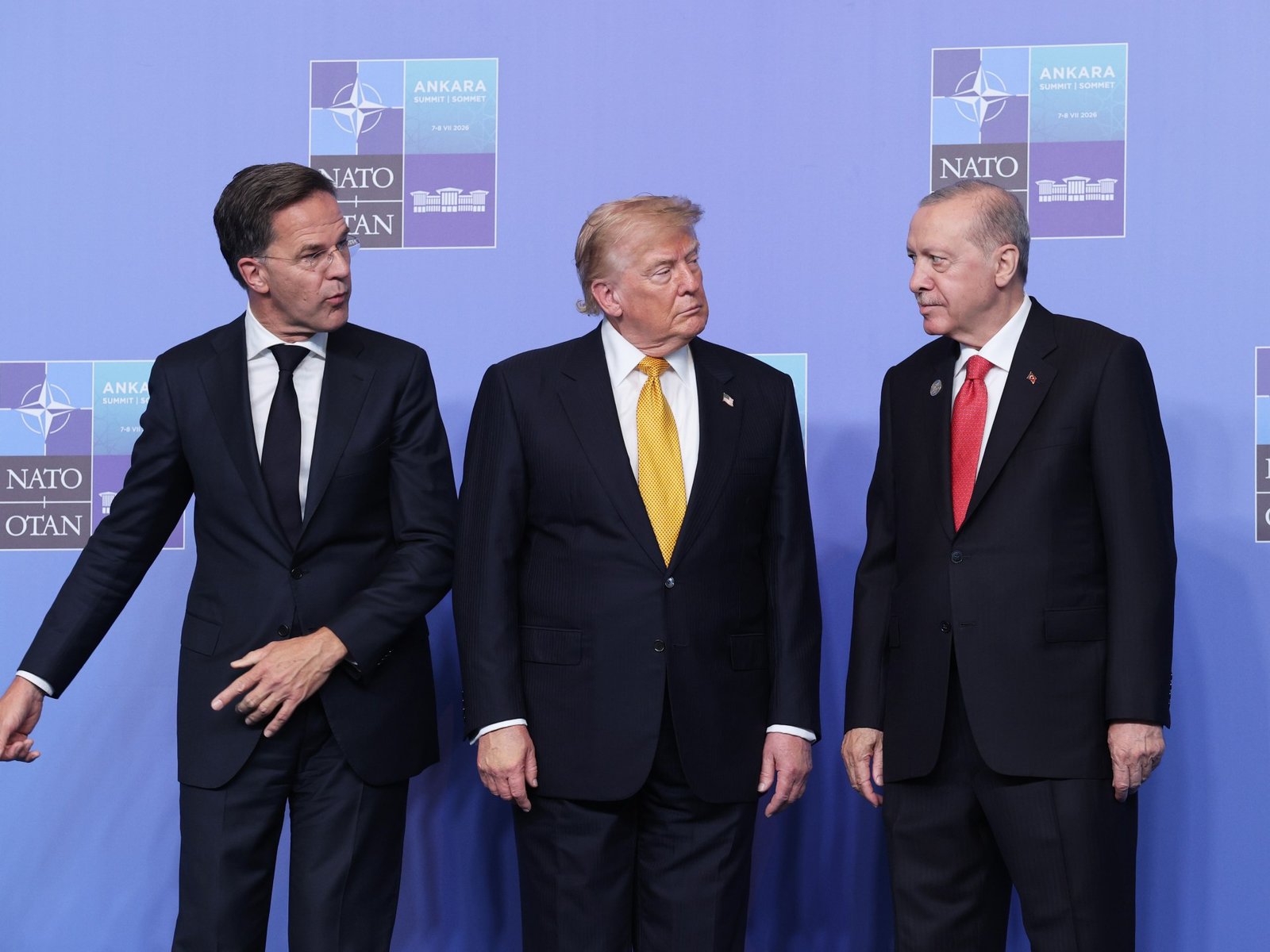
Is Trump’s presence at the NATO meeting in Turkey, among many anti-Iranian statements and orders to attack Iran, just to participate in a diplomatic meeting of European security? This question is very important because recent events cannot be understood on the surface alone.
In depth, Trump’s presence also indicates a recalculation of the United States’ strategy in relation to the Islamic Republic of Iran and the “axis of resistance”. This revision is based on the assumption that direct military, political and economic pressure, despite bringing in large sums of money, has failed to bring about the desired change in Iran’s behavior, power structure or strategy. Therefore, Washington is gradually moving away from the idea of direct pressure to a hybrid and diverse model, in which domestic pressure, the evolution of Iran’s environment, the renewal of regional cooperation and the simultaneous renewal of local documents form one part of the infrastructure.
The rationale behind this change is that Iran must be pressured not just by a single strike, but through a multi-pronged approach. The goal is not only to increase the foreign investment given to the Islamic Republic of Iran, but to establish conditions in which the decision-making apparatus of this country is forced to give a greater part of its capabilities in managing domestic, border and regional problems. In other words, the new US strategy was based on creating pressure simultaneously inside Iran, across the political spectrum and in all its connections.
At home, the process depends on increasing social norms and slowly destroying people’s resilience. The goal is not to cause occasional dissatisfaction or problems, but to increase the cost of governance by disrupting the most important tools and looking for ways to manage daily life, including energy, water, transport and other critical areas in public and economic affairs. Combined with security and regional constraints, these pressures may lead some in the Islamic Republic of Iran to make decisions away from key priorities and focus on domestic issues.
This part of the strategy, however, cannot be fully effective without changing the environment around Iran. From this point of view, the US and Israel want to renew the regional theater in which they simultaneously deal with Tehran on several borders. Recent developments have shown that, despite many military, security and intelligence operations, Hezbollah has not been removed from a significant level of power, and Palestinian resistance has not been contained. Ansar Allah (the Houthi group) has not given up its regional role, and the armed groups that are associated with the opposition in Iraq have not been removed from the political and security forces. These failures have led Washington to argue that Iran will not be weakened without immediate restructuring of its environment.
Within this system, three additional processes can be identified. The first is to bring Iran inside its ring and create security pockets in the west, northwest, southeast or northeast. The second is to increase pressure on Iran’s allies, from Lebanon and Palestine to Iraq and Yemen. The third is to achieve a small but significant gain that can be presented as proof of pushing Iran back or reducing the depth of its regional influence. In this perspective, even if limited, the operations and economic and security pressure on Iran should not be seen as isolated events, but as components of a higher structure.
Based on this, the NATO meeting in Turkey has a meaning that goes beyond the ordinary meeting. It is not just a forum for discussing European security, but a platform for connecting the Iran dossier with the Western security architecture. The US wants to elevate the Iran issue beyond the international debate and turn it into a Western consensus. From this point of view, NATO is not just a military alliance, but a vehicle for coordinating political, security and issues of the Western allies against Iran.
In this context, Trump’s presence at the conference can be understood as achieving four interconnected goals. The first is the integration of infrastructure cooperation against the Islamic Republic of Iran. The US wants to use dossiers such as Ukraine, strong defense and the stability of trade and energy channels to protect Europe’s main ties to Iran. The importance of the Strait of Hormuz and the consequences of instability in West Asia on the economic security of Europe allow Washington to connect European concerns with those that oppose Iran. However, the actions of other European countries show that the agreement will remain incomplete and that Washington still faces limitations in turning Europe into a sufficient partner in the campaign against Iran.
The second purpose is to agree on future actions. Washington is well aware of the high political and legal costs of dealing with Iran. Therefore it wants, by increasing the coordination of the regions, to put any other measures in a common and defensive way. In this sense, coalition building is not only a means of gaining power, but also a tool for creating legitimacy for future divisions.
The third objective is to connect with Turkey and use its peripheral powers. Any concessions made to Ankara should be understood in the light of the US’s efforts to bring Turkey closer to its structure. Borders, tribes and security around Iran, especially in the west and northwest, can take part in such a process. From this point of view, the US-Turkey negotiations cannot be understood as an attempt to improve bilateral relations. They also form part of an attempt to identify the source of the problem along Iran’s borders.
The fourth objective is to use Syria’s power to strengthen Lebanon and increase pressure on Hezbollah. Seen through these lenses, what is happening in Syria is not limited to the country itself, but it can be a platform to change the equation in Lebanon and force resistance. If we accept the fact that the US is uniting the documents of Syria, Lebanon and Turkey in a single agreement, these four objectives cannot be seen separately. They are links in a single chain of increasing political, security and underground pressure on Iran and the axis of resistance.
Along with these dimensions, several additional documents are also defined to use the same constructs. In Gaza, the Zionist government seems to have passed the debate on Hamas’s political agenda. Opposing the reconstruction in the areas outside the so-called yellow zones or security, now they want to establish a new policy of population and areas. The issue is not only about the political situation in Gaza, but the transformation of the territory into a residential area, tired and forbidden, which makes Israel look at the West Bank. There, the goals are security stabilization, deterrence and preventing the West Bank from becoming a permanent and permanent center of conflict. Therefore, Gaza and the West Bank are not two separate entities, but two sides of the same path of Palestinian resistance.
In Yemen too, there are signs that the Ansar Allah dossier is entering a new phase. According to the analysis, Israel established a “Desk Yemen” within the Mossad about eight months ago, a move that shows the importance of this dossier in the intelligence and accounting operations of the Zionist government. The time has now come to do some work on the desk, and make the Israeli and US objections against the Yemeni Ansar Allah possible soon. If this strategy is launched, Yemen will be another important arena for increasing pressure at the same time against the axis of resistance.
In Iraq, the maintenance or weakening of forces associated with the resistance is still not a US issue, and it becomes more important when considered together with other regional developments. Therefore, we are not facing different problems, but rather a combination of linked documents that are being followed in a multi-dimensional structure that wants to restore power in West Asia.
Taken together, these developments show that the US, instead of relying on a single weapon, is creating challenges against the Islamic Republic of Iran. Domestic pressure, pressure on Iran’s borders, pressure on regional allies and pressure exerted by the international community are part of the shared infrastructure. His main goal is to redefine the balance of power in West Asia in favor of the US and the Zionist regime, and to force Iran to focus on managing difficult, complex fronts.
However, this strategy will inevitably fail. Recent years have shown that many of the US and Zionist structures, despite their military power, political support and complex security networks, can be confused, confused and fail when faced with the reality on the ground, the obstacles presented by the local situation and the deep determination of the opposition. In addition, the funeral that millions of people met for the general killed in Iran and Iraq has also shown that the real and stable order in West Asia is created not through the foreign technology of America, but around the will of the nations, remembering the history of resistance and the deep relationships that were created through opposition to the regime. Therefore, although Washington is trying to reassert its pressure on Iran with a method of resistance through a more complex and multi-faceted approach, the political and social events in the region show that this project, like previous comparisons, is facing its internal failures, exhaustion and final defeat. Therefore, the emerging order in West Asia cannot be thought of as an American whim, but rather the gradual rise of a well-known, entrenched and anti-American system of foreign-made and foreign-made projects.
The views expressed in this article are those of the author and do not reflect Al Jazeera’s editorial policy.



