Physical Address
304 North Cardinal St.
Dorchester Center, MA 02124
Physical Address
304 North Cardinal St.
Dorchester Center, MA 02124
International sports institutions have long maintained that football exists in isolation from political conflict, but historical evidence consistently proves that stadiums often reflect political polarization.
This interference does not stop with crowd chants, but extends to big tournaments, especially the World Cup, with the game’s most famous stars being left out of their country’s teams for purely political reasons, often overshadowed by technical justifications.
“Barcelona” star breathes a sigh of relief after saving “Valencia”.
Video: Mourinho watches Real Madrid’s ‘perfect’ goal in the heart of Berlin
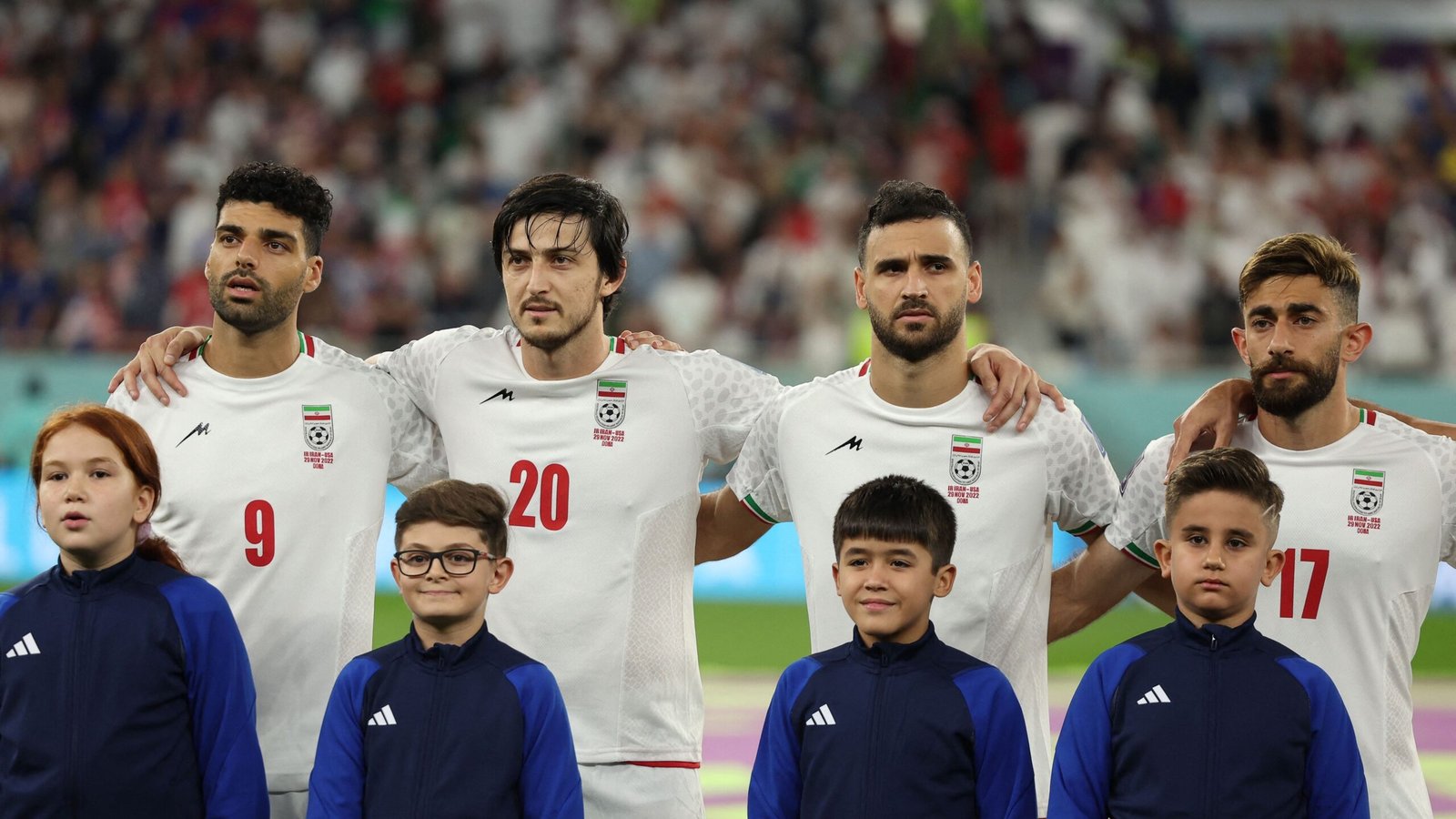
The case of Iranian striker Sardar Azmoun embodies the latest chapter of political influence on football.
Although Iran’s federation and national team coach Amir Kalinoui justified the player’s exclusion from the preliminary list on technical grounds, citing his previous injuries during his time with the UAE’s Al-Ahly youth team, the decision came after Azmoun was accused of “betrayal” by state media, raising many doubts.
The roots of the crisis go back to the fact that Azmoun (31 years old) published a photo of himself on social media platforms with Sheikh Mohammed bin Rashid Al Maktoum, the ruler of Dubai, last March.
Neither his artistic value helped Azmoun, who is Iran’s third all-time top scorer with 57 goals in 91 games behind Mehdi Taremi and Ali Daei, nor the solidarity of his teammates, such as Taremi, who expressed his absence. The government’s ire against him redoubled due to his previous support for popular protests in late 2025, which saw him threatened with confiscation of his assets and a ban on international football.
Thus, Iran will be without an attacking pillar in Group 7 of the 2026 World Cup, where they will face New Zealand, Belgium and Egypt.
Historically, the positions of some stars have come under pressure from the authorities, as was the case with Chilean legend Carlos Casile, Colo-Colo’s all-time top scorer.
Caseli was known for his strong opposition to the dictatorship of General Augusto Pinochet. In a famous situation before the team traveled to the 1974 World Cup, Caselli refused to shake Pinochet’s hand in public, placing his hand behind his back.
Caseli paid the price for her opposition as the regime tortured her mother in revenge. His athletic failures on the field were used politically to undermine his symbolism. When he received the first red card in World Cup history against West Germany in 1974 and missed a penalty against Austria in the 1982 World Cup, the pro-regime media launched a frenzied campaign to portray him as a traitor and a failure.
Despite the restrictions, Caselli stuck to his position and rejected the dictator’s threats, until in 1988 he strongly participated in the “No” campaign that overthrew Pinochet.
In June 2009, Iranian authorities took advantage of the World Cup qualifying match against South Korea in Seoul to take revenge on some of the stars of the national team.
Six players, led by legend Ali Karimi, captain Mehdi Mahdavikia, Vahid Hashemian and Hossein Kaabi, took to the field wearing green armbands in solidarity with the opposition Green Movement, which was protesting Mahmoud Ahmadinejad’s re-election.
Despite heavy pressure to send him off at half-time, captain Mahdavikia insisted the green badge be kept throughout the match.
The government’s punishment came shortly after he returned to Tehran. Their passports were confiscated, they were completely banned from making statements to the media, and four were forced into international retirement as a punishment, to exclude the active golden generation by a purely security decision.
The policy of exclusion was not limited to Asia and Latin America; In May 1990, a bloody riot broke out in the stadium during a Yugoslav League match between Croatia’s Dinamo Zagreb and Red Star Belgrade.
Then Dinamo Zagreb’s rising midfielder Zvonimir Boban intervened to protect a Croatian fan from an attack by a Yugoslav policeman, targeting him with the famous flying kick that has become a symbol of the Croatian resistance.
The reaction of the Yugoslav Football Federation was severe. Boban was suspended for six months, which prevented him from participating in the finals of the 1990 World Cup in Italy.



