Physical Address
304 North Cardinal St.
Dorchester Center, MA 02124
Physical Address
304 North Cardinal St.
Dorchester Center, MA 02124
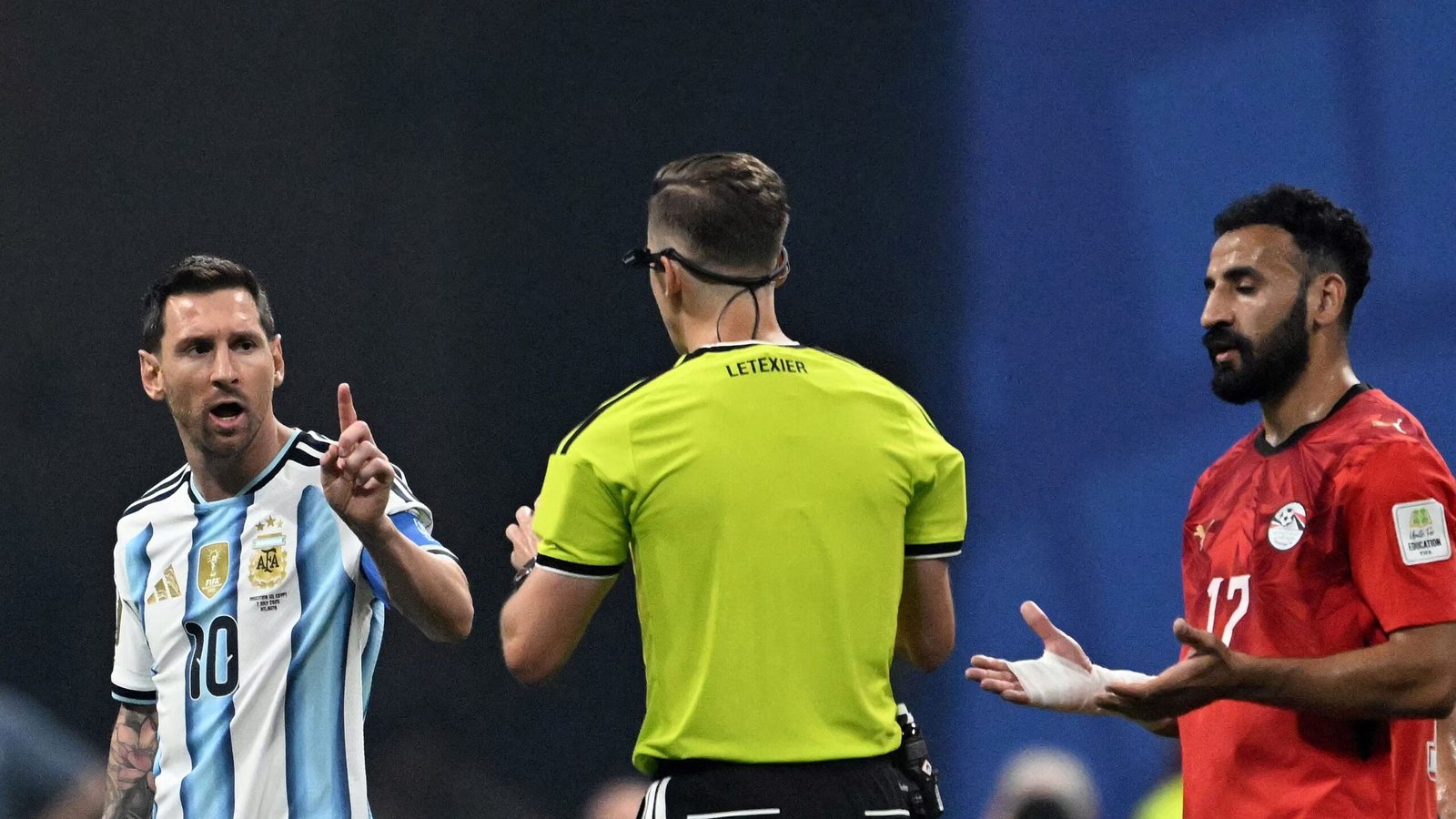
At every major tournament, accusations against the International Association of Football Associations (FIFA) and match referees resurface amid directives to interfere or favor certain teams or stars. As controversies flared over the 2026 World Cup, former England assistant referee Darren Kane, who previously worked at the 2010 and 2014 editions, dismissed these stories based on his experience during the tournament, stressing that referees work completely independently and that talk of collusion or collusion will do nothing.
Many fans believe that based on the information circulating on social media platforms and various websites, the International Football Federation (FIFA) is looking to crown Argentina and Lionel Messi with the World Cup title and that the referees are involved in this plan.
But former England assistant referee Darren Cann has strongly denied the allegations, stressing that referees are constantly facing baseless accusations of being part of a “conspiracy theory”, which he describes as outright lies.
He explained that he had the honor of serving as an assistant referee at the 2010 and 2014 World Cups in the refereeing team that included head referee Howard Webb, along with assistant referee Michael Malarkey, stressing that the staff is completely independent and makes its own decisions, and that this approach has not changed to this day.
He noted that the referees participating in the World Cup come from different countries of the world and their national and continental federations, and FIFA uses them for a period not exceeding six weeks, and during that time they work completely separately from the officials of the international federation.
He added to the BBC “BBC:“ The referees live in their own camp and do not meet with FIFA administrative officials, strongly denying any secret meetings or special instructions directing certain results.
He emphasized that the referees’ daily schedule is very tight, as it includes physical training, watching video clips, analyzing the previous day’s matches, as well as preparing for the upcoming matches, which leaves them no time for such claims.
He emphasized that the rumors about the existence of a plan to ensure Messi’s final match have nothing to do with reality. He also commented on rumors that FIFA wanted to host the final between Argentina and Spain to feature the iconic “flag handover” between Messi and Lamin Yamal.
He said he was not personally aware of the existence of the famous photo of Messi with Balamen Yamal when the latter was a child, suggesting that most of the referees participating in the tournament were not aware of it either.
Darren Kahn admitted that referees sometimes make mistakes as it is part of human nature and that some decisions may appear to be against a particular team or national team, but this is due to the speed of the game, not the presence of pre-orders.
He added that referees do not judge games by the names of players or teams, but only by what they see on the field.
He cited with Howard Webb the match between Barcelona and Bayern Munich in the Champions League, when Lionel Messi fell in the penalty area, but the staff did not award a penalty.
He explained that the next day, as after every match, they watched the footage and admitted that the decision was wrong, but at the time they made it with complete honesty and conviction, regardless of the identity of the player or the team.
He emphasized that the referee makes his decision in less than a second and often does not have time to find out the identity of the player. Rather, he simply sees the red shirt facing the blue shirt, and then judges the incident as he sees it.
He pointed out that the spread of conspiracy theories causes real harm to rulers, subjecting them to abuse and psychological pressure, which can sometimes extend to threatening their families.
He noted that the head of FIFA’s refereeing committee, Pierluigi Colina, had to defend the refereeing team after Argentina’s 3-2 victory over Egypt in the round of 16, after Egyptian fans accused French referee Francois Letexier and his team of deliberate bias against Argentina.
He emphasized that Colina was right to warn of the seriousness of these accusations, as they can turn into direct threats to referees and their families, noting that he has witnessed such incidents, although he considers himself lucky not to have been subjected to them personally, perhaps because he is an assistant referee and not an arena referee.
He also recalled his memories of the 2010 World Cup final between Spain and Holland, officiated by their referee teams, describing the day as one of the proudest moments of his career.
He explained that the match was one of the toughest of the refereeing, having witnessed 14 yellow cards and the sending off of Dutch defender Jonny Heitinga, with widespread arguments that Nigel de Jong also deserved a red card.
He added that they were subjected to severe criticism from Dutch coach Bert van Marwijk, stressing that these pressures are a natural part of the referee’s profession as long as he makes his decisions honestly and fairly.
He noted that some referees, such as England’s Michael Oliver and Anthony Taylor, have faced threats over their decisions in recent years, considering such behavior to be completely unacceptable, and that their strictness is being increased by reports that question the referees’ impartiality.
He said that despite his encouragement for England, he did not believe the referee was the reason for the Three Lions’ exit against Argentina, explaining that he had seen the referee be lenient in the first 25 minutes, but it was not the deciding factor in the outcome of the match.
He added that it is very disappointing that conspiracy theories continue to circulate even though a referee is under enormous pressure and makes fateful decisions in just a split second, when those decisions can have huge financial and sporting consequences.
He emphasized that the presence of refereeing errors does not mean the presence of collusion, citing several instances in the tournament, including Germany’s goal against Ecuador that should have been disallowed due to dangerous play, and the penalty that should have been awarded to Ghana against England after interference by Ezri Konsa, in addition to the correct goal against Brazil that was disallowed.
He explained that after playing 103 matches, the equivalent of roughly ten rounds of the English Premier League, some mistakes become commonplace and difficult to avoid.
At the end of his speech, he reflected on the appointment of Slovenian referee Slavko Vinčić to officiate the World Cup final, stressing that the match represented the pinnacle of his refereeing career and that his great excitement when his name was announced by Pierluigi Colina reflected the value of this achievement.
He concluded by saying that Vincic, like any referee in a World Cup final, does not care at all about the identity of the champion, but his entire focus is on getting out of the game without making mistakes that affect the result, stressing that this is the only concern of any referee and that everything raised about the existence of conspiracies is nothing more than baseless accusations.



